.avif)
This guide is designed for you — to help you evaluate options abroad with clear information, without any sales pressure.
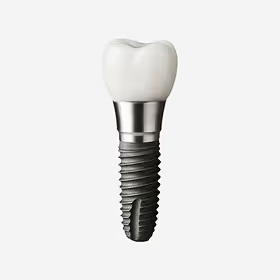
Every year, tens of thousands of English people choose to undergo dental treatment outside the UK. This is not a passing trend - it is a concrete response to a real problem.
.avif)
.avif)
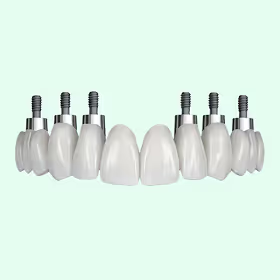
Savings can reach 60–70%. But why is it cheaper?
That said, not all foreign clinics are the same. Real savings are only achieved by choosing wisely.
Price is just one of the factors to consider. Here are the most important criteria to evaluate before choosing.
Always ask which brand of implants is used. Manufacturers with certified international standards include:
- Straumann (Switzerland)
- Nobel Biocare (Switzerland/USA)
- Dentsply Sirona (USA)
- Osstem (South Korea — very common in Eastern Europe)
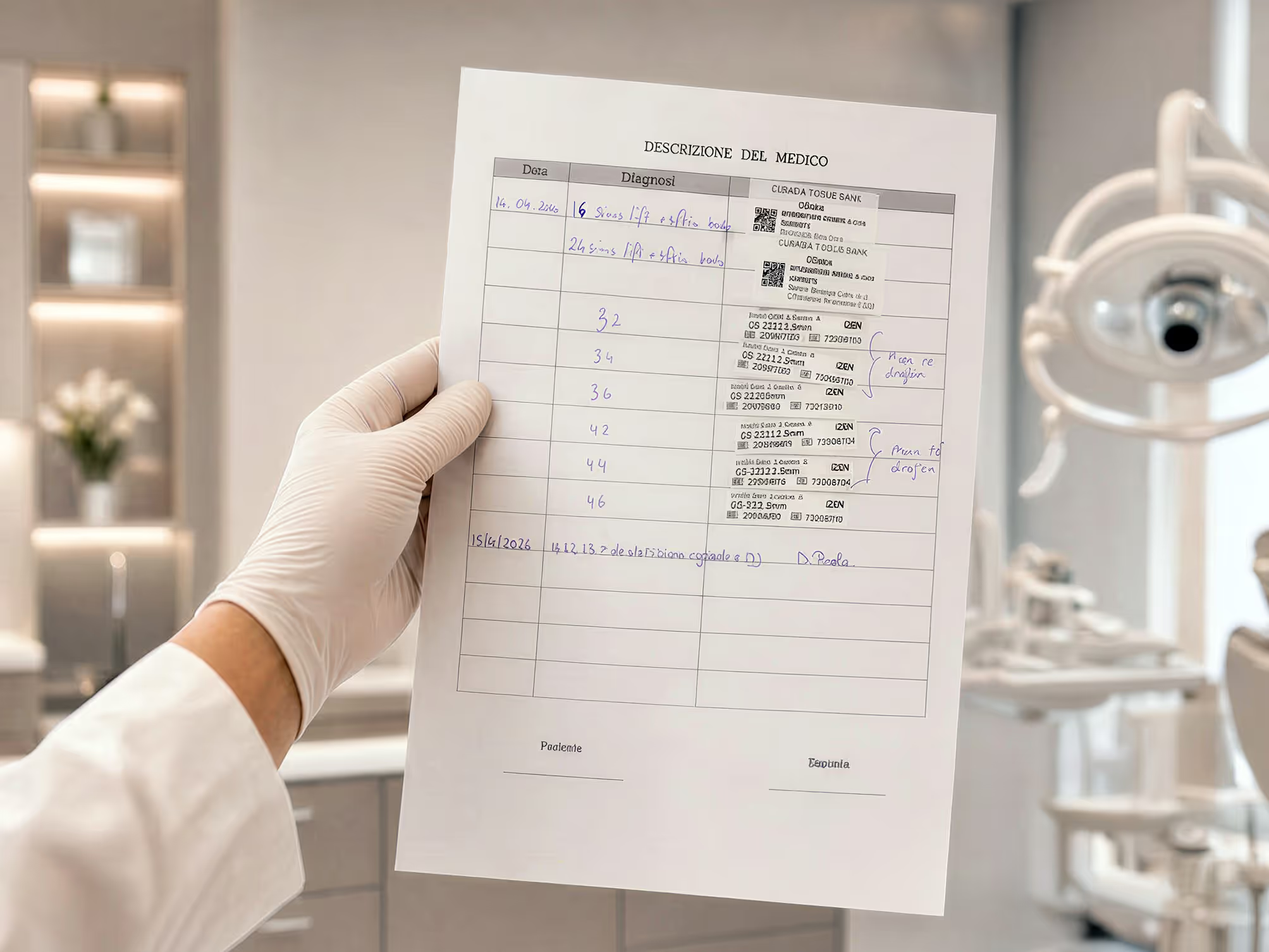
A reputable clinic provides complete documentation of the implanted material — brand, batch code, CE certification. If not provided voluntarily, ask explicitly.
It is not enough that there is a 'dentist'. For implants, the relevant figure is the implant surgeon. Check:
- Specialisation in implantology (not just general dentistry)
- Years of specific implant experience
- Experience with complex cases (extractions, insufficient bone)
- Photographic portfolio of treated cases
A reputable clinic will not give you a quote without first analysing your situation. The correct process is:
1 - You send your orthopantomogram (panoramic X-ray)
2 - The team analyses bone quality and quantity
3 - You receive a personalised plan — not a standard quote
4 - Only then are timing and costs discussed
This is one of the most underestimated aspects. After the procedure you will need:
- Follow-up checks (usually at 3–6 months)
- A contact person reachable for questions or unexpected issues
- Support even remotely, including in UK
Ask explicitly: 'If I have a problem once I return to UK, what happens?'
.avif)
Not all risks are obvious. Here are the most common ones, with warning signs to spot early.
The savings compared to your country are real, but there is a limit. If a quote is significantly lower than other foreign clinics - not English - ask yourself why. It often indicates unknown brand implants, lower quality crowns, or shortened procedures.
As already mentioned: without prior radiographic analysis, the quote is just a guess. Procedures performed without proper assessment can lead to complications, incorrect placement, or the need for re-intervention.
If something goes wrong in the future - or if you need to see another dentist in UK - you will need to know exactly which implant was placed. Without written certification, that information is lost.
If you don’t clearly understand what the price includes, how many sessions are planned, or what happens in case of complications – stop. A professional quote is detailed and readable, not generic.
Some clinics focus exclusively on the surgical phase. Once back in UK, you’re on your own. This is the most serious risk, as complications – when they occur – often arise in the weeks following.
This is a topic rarely discussed, but very important.
When an implant is placed, you are introducing a medical device into your body. As with any medical device, there is — and must be — formal documentation.
- Brand and model of the implant
- Batch number (manufacturer traceability)
- CE certification of the device
- Type of crown: zirconia, metal-ceramic, etc.
- Date of the procedure and surgeon's name
Zirconia is now considered the benchmark material for implant crowns. It is biocompatible, durable, naturally aesthetic, and does not cause reactions in surrounding tissues. Unlike metal-ceramic, it does not darken the gum over time.
Not all clinics use it by default — some offer cheaper materials without the patient being fully aware. Explicitly ask which material will be used for the crown.
For every treatment, we provide the patient with full certification — implant and zirconia crown — including all traceability data. This document is yours, and you can take it with you to any dentist.
One of the most common concerns is logistics. How many times do I need to travel? How long does the procedure take? What happens if I need something once I’m back?
Here’s how a well-structured journey works:
You send your panoramic X-ray. The team analyses it within 24–48 hours and contacts you to discuss your case.
You receive a clear document with: proposed treatment, materials, number of sessions, timelines, full costs with no hidden fees.
The trip is planned in advance. The first session includes consultation, any extractions, and implant placement. Duration depends on case complexity.
After the osseointegration period (usually 3–6 months), you return for the placement of the final zirconia crowns.
You receive full certification — implant and crown. The team remains available for any questions, even after you return to UK.
.avif)
Before making any decision, use this checklist. You can copy it and use it literally in your communications with the clinic.
Print it out and use it as a reference in your evaluation.
Dental implants are not an impulse purchase. They are a medical procedure that requires care, assessment, and trust in the team supporting you.
If you have read this guide to the end, you have already done the most important thing: you are informing yourself before deciding.
Request multiple quotes. Ask the questions from this checklist at every clinic you are considering — including ours. A clinic that responds clearly, transparently, and without commercial pressure is one that respects you as a patient.
If you want to find out if you are a suitable candidate for implants and get a clear idea of the costs for your specific situation, you can send us your scan with no obligation.
- We analyse your X-ray free of charge
- We send you a personalised plan with a detailed quote
- No pressure, no obligation
- Implant and zirconia crown certification included in the treatment